
Bridge Financing & Private Debt
Rescuing Distressed Assets: How South Florida Investors Use Short-Term DSCR Bridge Loans
How short-term DSCR bridge loans, lower-leverage hard money, and interest-only balloon structures can help South Florida investors fund a distressed or transitional property, and why the exit matters most.
Across Miami-Dade, Broward, and Palm Beach counties, some commercial property owners are facing overlapping pressure from higher insurance costs, deferred capital needs, maturity risk, vacancy, and tighter lending conditions. Commercial windstorm insurance premiums have risen for many owners, older buildings in Miami-Dade and Broward can be subject to county 40-year building safety recertification programs, and some commercial mortgages originated during the low-rate period of 2019 to 2021 are now approaching their balloon maturities. For broader Florida market context, organizations such as Florida Realtors publish ongoing research on the state's real estate conditions.
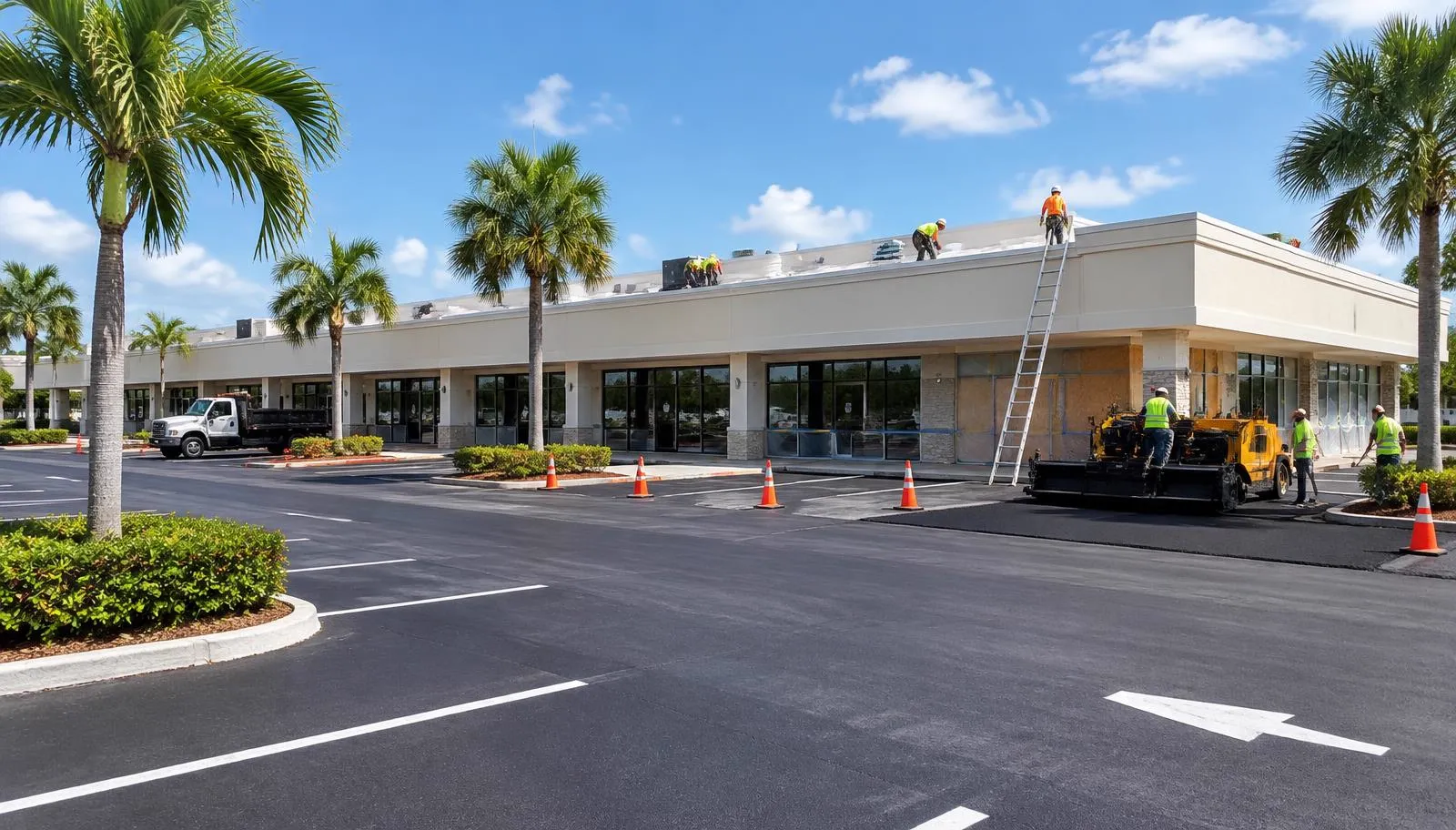
When a multi-tenant retail plaza or an older small-bay industrial park needs a major roof replacement to address a compliance or safety issue, or when a balloon payment comes due, a conventional bank may be reluctant to lend. Many bank underwriters are cautious about active distress scenarios, and a property that does not meet the bank's Debt Service Coverage Ratio (DSCR) requirements can be difficult to refinance on conventional terms.
In those situations, some investors and owner-operators turn to specialized private capital. Short-term DSCR bridge loans and lower-leverage hard money structures can be used to acquire a distressed asset, fund capital expenditures, and stabilize the property before seeking longer-term financing. This guide explains how interest-only commercial bridge loans are commonly structured and how investors think about private capital for South Florida acquisitions.
1. The Short-Term DSCR Bridge Loan Structure
Traditional commercial banks place significant weight on the borrower. They commonly request several years of personal and business tax returns, profit and loss statements, and a global cash flow analysis to confirm the borrower can support the debt. If an operating business had a weak year, a bank may decline or reduce a commercial mortgage even when the property itself performs well.
Some real estate backed lenders place greater emphasis on property cash flow, collateral value, and the planned exit than traditional bank underwriting, although borrower, sponsor, guarantor, and property requirements vary by lender. DSCR-based programs generally evaluate the relationship between qualifying property income and required debt service, but calculation methodology varies.
DSCR generally compares qualifying property cash flow with required debt service. Required DSCR thresholds vary by lender, property type, leverage, occupancy, sponsorship, and loan structure. As an illustrative threshold, a ratio of 1.0x means qualifying cash flow roughly equals the required debt service, with no cushion above it.
For transitional assets with high vacancy, the analysis can look different. Certain asset-based or lower-leverage bridge programs, sometimes described as "no-ratio" loans, may place less emphasis on in-place cash flow, particularly for transitional or vacant assets. Underwriting still depends on lender guidelines, collateral, sponsor strength, property condition, leverage, title, and exit strategy. Where available, this kind of structure may let an investor acquire a largely vacant warehouse with short-term bridge financing and carry out a lease-up plan before the property needs to support conventional debt.
2. Low-LTV Hard Money: Trading Leverage for Execution Speed
In commercial real estate finance, higher leverage tends to create more underwriting friction. A request for an eighty percent Loan-to-Value (LTV) commercial mortgage puts more of the lender's capital at risk, so the lender will usually want more time for environmental, structural, and financial review.
Distressed acquisitions, such as a tax deed sale, an auction, or an urgent partner buyout, often come with a short execution window. Bridge financing can often move faster than conventional bank financing, which may be important when an acquisition or maturity has a limited execution window.
This is where lower-leverage hard money comes in. Requesting a smaller loan amount, for example fifty to sixty-five percent of the property's current as-is value (illustrative range only), gives the lender a larger equity cushion. Lower-leverage bridge structures can provide a larger collateral cushion and may simplify portions of underwriting, although available leverage depends on the lender, property, sponsor, market, and business plan. Private real estate lenders may place greater emphasis on collateral value, leverage, property condition, sponsor experience, and a credible exit strategy. Valuation, title, and other diligence still apply. A potential or illustrative timeline might be ten to fourteen days, subject to underwriting; lower leverage does not by itself guarantee a faster closing.
As Jason discusses in Why Small Businesses Fail Before They Even Start, a lack of operational flexibility can be costly. Accepting a lower LTV is a deliberate trade-off: you bring more cash to closing in exchange for a better chance of closing within the window. If you have a transitional property and a tight timeline, talk to Price Capital Group about commercial bridge financing.
3. Interest-Only Payments and the Balloon Maturity
A commercial bridge loan is generally designed for short-term, value-add execution. Many standard bank loans amortize, so part of each monthly payment reduces principal. That higher debt service can draw down the cash flow an owner needs to renovate the building.
Many bridge loans use interest-only payment structures during the initial term, although payment structures vary by lender and transaction. An interest-only payment can lower monthly debt service and preserve cash for tenant improvements, new overhead doors, or concrete spalling repairs.
Bridge loans are generally short-term facilities and may include a balloon maturity. Actual loan terms vary. A term of twelve to twenty-four months is an illustrative common structure, not a guaranteed Price Capital Group term. At maturity, the remaining principal is typically due in full.
As discussed in The Discipline Loop: Why Your Process Beats Your Goals, an interest-only loan with a balloon payment calls for operational discipline. Because bridge financing is temporary by design, borrowers should underwrite a realistic repayment or refinance strategy before entering the loan. For more on maturity risk, see Surviving the Commercial Mortgage Balloon.
4. Engineering the Exit Strategy
A bridge loan is a temporary runway, not a permanent home. The plan to repay it should be in place before the balloon maturity approaches, because a missed maturity can expose the borrower to default remedies under the loan documents.
- The Refinance Exit: The owner uses the bridge term to address non-paying tenants, complete deferred maintenance such as a roof replacement, improve occupancy, and sign new leases at market rents. If stabilization improves the property's cash flow and underwriting profile, the borrower may later seek longer-term financing, subject to market conditions and lender requirements.
- The Sale-Leaseback Exit: An owner-operator who used a bridge loan to protect its own facility, for example during a tax lien or partner dispute, may consider a corporate sale-leaseback. An owner-occupied business may also evaluate a sale leaseback, subject to property value, lease economics, existing debt, taxes, closing costs, and negotiated terms. Many of these transactions use a long-term Triple Net lease. See our hard money vs. sale leaseback comparison.
- The Direct Sale Exit: If the property's physical issues are severe, or compliance costs exceed available reserves, a direct off-market sale may be worth evaluating. A direct acquisition may provide another exit path when the owner prefers to sell rather than complete the stabilization plan. Transaction terms remain subject to diligence, title, property condition, pricing, and the purchase agreement.
Price Capital Group evaluates real estate backed financing and acquisition opportunities based on the property, sponsor, capital need, transaction structure, and exit strategy.
To see how your property's numbers look under current assumptions, try our cap rate calculator. If you are facing a balloon maturity, working through a 40-year building recertification, or need bridge capital to secure a South Florida asset, you can Submit a Property for a confidential review, or discuss your DSCR bridge financing scenario with our team.
Related Reading
This article is general educational information and does not constitute legal, tax, lending, or investment advice. Figures are illustrative. Loan terms, rates, fees, timing, and approval are subject to underwriting and vary by lender, property, and borrower. Building recertification and inspection requirements vary by county and building type. Consult qualified advisers before any financing, sale, or lease.