
Commercial Real Estate
The Definitive Guide to Cap Rates in Commercial Real Estate
Learn how commercial real estate cap rates measure yield, risk, financing pressure, and property value, and why advertised pro-forma returns require careful underwriting.
Introduction
In commercial real estate, one metric dominates every conversation and underwriting model: the Capitalization Rate, or cap rate. It is the universal language of commercial property valuation, but relying on it blindly without understanding the operational and market mechanics beneath it is one of the fastest ways to lose capital.
A property's advertised cap rate is only a starting point. Here is how cap rates actually work, how they measure risk, and how institutional investors use them to force appreciation.
The Cap Rate Formula and Core Mechanics
A cap rate represents the unleveraged annual rate of return an investor would receive if they purchased a property entirely in cash. It is a single-year snapshot of yield.
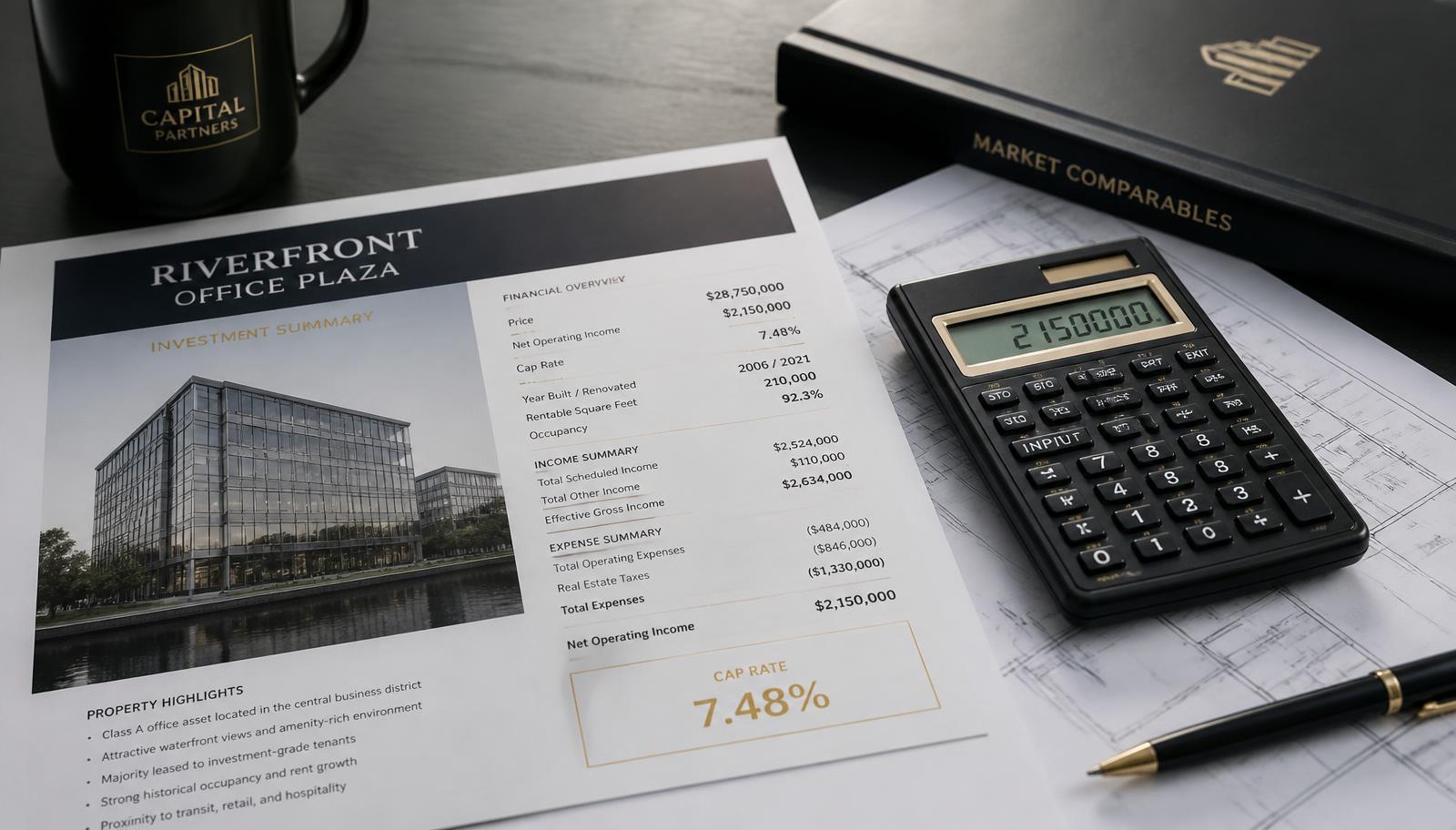
Cap Rate = (Net Operating Income ÷ Purchase Price or Current Market Value) × 100
If you buy a self-storage facility for $5,000,000 and it produces $350,000 in NOI, the asset is operating at a 7% cap rate.
Value vs. Yield: The Inverse Relationship
As cap rates compress, values go up. As cap rates expand, values go down. If that same $350,000 NOI is valued at a 5% cap rate, the property is worth $7,000,000. Property Value = NOI ÷ Market Cap Rate.
What a Cap Rate Actually Tells You
A cap rate is fundamentally a measure of risk. Low cap rates (5% to 6%) apply to stabilized, credit-tenant NNN assets like the freestanding retail deal we broke down on Commercial Real Estate Lending: The Burger King Deal. High cap rates (9% and up) compensate buyers for operational friction on value-add multifamily and mismanaged assets. Organizations like the CCIM Institute teach how to translate risk into required yield.
The Danger of the Pro-Forma Cap Rate
Brokers frequently market on projected pro-forma income rather than trailing-twelve-month reality. On The Route EP 1: Commercial Property Inspection Gone Wrong, we inspected a 34,000 sq ft building listed at $8.9M with $367,000 in claimed NOI. On paper that penciled to a 4% cap. On the ground, drainage failures, failing lots, and below-market rents meant a realistic 6% cap only supported roughly $6M in value. A $3M gap between the flyer and the math.
Cap Rate Spread and Interest Rates
Cap rates track Treasury yields and commercial mortgage rates. Borrowing at 4% to buy a 6% cap creates positive leverage; borrowing at 7% for the same 6% cap creates negative leverage. When debt is expensive, buyers demand higher cap rates and values fall.
Bypassing Market Fluctuations with a Direct Cash Exit
A direct off-market sale to a corporate cash buyer removes appraisal and financing contingencies. The valuation you agree on is the amount funded at closing. Stress-test your numbers with our cap rate calculator, then Submit a Property for a confidential review. For a full breakdown of private transactions, see our guide on selling commercial property off market.
Continue
Submit a Property