
Hard Money & Alternative Capital
Acquiring Bank-Owned REO Commercial Assets in South Florida: The 10-Day Hard Money Execution
How investors weigh accelerated REO acquisitions, bridge financing, repair reserves, and a planned refinance exit.
Some South Florida commercial properties have entered distress because of higher borrowing costs, insurance pressure, maturity risk, deferred maintenance, and property-specific operating challenges. Building recertification, structural inspection, or milestone-inspection requirements may create additional capital needs depending on the property and jurisdiction. Warehouses, retail plazas, and aging office buildings can each face different operating and repair challenges.
REO means Real Estate Owned. REO generally refers to real estate a lender has taken into ownership following foreclosure or another recovery process. Not every distressed asset is REO, and lender ownership does not establish the property's condition or income.
Banks generally seek to manage and dispose of foreclosed real estate because REO can create carrying costs, capital considerations, operational burdens, and regulatory scrutiny. Bank-owned real estate can affect regulatory capital, reserves, risk management, and asset-quality considerations depending on the institution and applicable regulatory framework. The Office of the Comptroller of the Currency's Other Real Estate Owned handbook discusses management, disposition, expenditures, and supervisory risks for covered institutions. It does not establish standard acquisition discounts or closing deadlines.
Asset managers may have internal timing, disposition, provisioning, or portfolio-management objectives that influence sale strategy. REO pricing can vary materially based on condition, occupancy, title, environmental risk, deferred maintenance, market demand, and the seller's disposition strategy. A below-market asking price is not, by itself, evidence of a profitable acquisition.
Some REO sellers prioritize shorter due-diligence and closing periods and may prefer offers with limited financing contingencies. A 10 to 14 day closing period is an illustrative accelerated-closing scenario, not a universal seller requirement. The "10-Day" execution in this article's title is illustrative, not a promised closing date. The opportunity depends on combining an appropriate acquisition basis with financing and diligence that can actually be completed.
1. The Execution Gap: Why Traditional Capital Can Struggle with REO
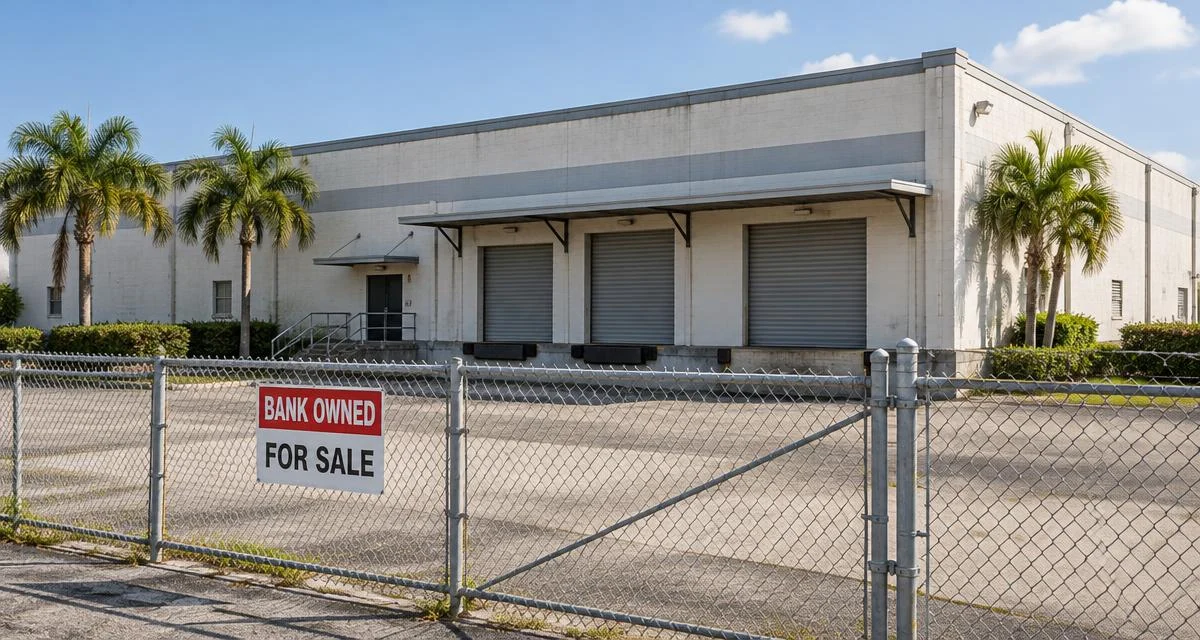
Consider a bank-owned Broward County retail center offered on an accelerated schedule. Offers dependent on longer conventional financing timelines may be less competitive in accelerated REO sales. That does not mean conventional financing cannot fund REO. It means the buyer needs to reconcile the seller's schedule with the lender's process.
Three issues often deserve particular attention:
- The Timeline: Conventional commercial financing can require additional time for appraisal, environmental review, underwriting, property-condition diligence, and borrower analysis. A 90 to 120 day process is an illustrative conventional-financing timeline only. Actual timing varies, and some transactions can move faster.
- The DSCR Analysis: Debt Service Coverage Ratio (DSCR) compares operating income with debt service. Some REO assets have weak or unstable cash flow, which can make DSCR-based underwriting more difficult. Lenders may discount uncertain or non-stabilized income when sizing debt. REO status does not automatically mean zero Net Operating Income (NOI), severe vacancy, or loan denial.
- The Collateral Condition: Property condition, deferred maintenance, open permits, code issues, environmental matters, and structural concerns can reduce lender appetite or loan proceeds. Roof leaks or an unresolved safety inspection may require additional diligence, repairs, or reserves rather than making financing impossible.
Accelerated REO sales can create a timing mismatch for buyers relying on longer conventional financing processes. Some buyers may negotiate limited or shorter financing contingencies to strengthen an offer, but doing so can materially increase buyer risk. Buyers should evaluate their ability to fund and close, and obtain qualified legal advice before changing contractual protections.
2. The Hard Money Acquisition Strategy
Private bridge or hard-money financing may allow investors to pursue time-sensitive acquisitions when conventional financing is too slow or property cash flow is not yet stabilized. Investors comparing hard money commercial lenders Florida opportunities should evaluate the full financing structure, not just the advertised speed.
Private bridge financing follows a different underwriting process than conventional bank financing. It does not remove applicable legal or regulatory requirements. Private lenders may place significant weight on current collateral value, projected value after rehabilitation, cost to complete, leverage, sponsor strength, liquidity, and exit strategy. Rent rolls, borrower financials, and documentation can still matter.
After Repair Value (ARV) is the projected value after the planned repairs, repositioning, or stabilization work is completed. In an illustrative lower-leverage bridge structure, leverage might be 60% to 65% of an accepted value basis. Leverage varies by current value, purchase price, rehabilitation budget, sponsor, property type, liquidity, lien position, and exit strategy. Lower leverage does not eliminate lender or borrower risk.
Some private bridge transactions may close on accelerated timelines when title, valuation, diligence, borrower documentation, insurance, and underwriting are complete. A ten-day closing is not assured. Private bridge financing generally carries a higher cost than conventional permanent debt. Rates and fees vary materially by transaction.
Illustrative value scenario only
Suppose a commercial property's projected stabilized value is $5,000,000 and its REO purchase price is $3,500,000. The gross difference is $1,500,000. This is a hypothetical value spread, not guaranteed equity, immediate profit, or risk-free arbitrage.
The analysis still must account for valuation uncertainty, repair costs, closing costs, financing costs, taxes, carrying costs, market risk, and execution risk. The projected stabilized value may not be realized.
As an illustrative financing cost only, suppose interest totals $150,000 over twelve months. This is not Price Capital Group pricing or a quote for a specified loan balance. The financing cost should be evaluated against the expected acquisition discount, rehabilitation budget, carrying costs, and projected exit value. It is not a mathematically irrelevant expense.
The broader business perspective in Why Most Businesses Fail Before They Even Start provides context for evaluating tactical spending. Investors may evaluate higher-cost bridge financing as part of the total acquisition cost, but that framing does not determine its accounting or tax treatment.
Talk to our team about financing for a bank-owned commercial property acquisition. For another planned acquisition-to-refinance approach, see the Bridge-to-SBA strategy for South Florida owner-operators.
3. The CapEx Holdback and Stabilization Phase
Acquiring the REO asset is only the first step. Physical and operating issues may require additional capital after closing. A realistic rehabilitation budget should address the work needed to improve the property without exhausting the sponsor's operating liquidity.
A bridge loan may include a controlled repair or Capital Expenditure (CapEx) reserve. The lender may hold back approved rehabilitation proceeds and release funds through documented draws as work is completed. Depending on the structure, acquisition proceeds are funded at closing while approved repair proceeds remain subject to draw conditions.
Examples include roof repair, parking-lot work, and municipal code remediation. Draws may be released based on invoices, inspections, lien waivers, completed work, or other lender requirements. Not every loan includes a holdback, all repair costs are not necessarily funded, and a reserve does not guarantee completion. The sponsor needs to understand reimbursement timing, required equity contributions, and how overruns will be covered.
Many bridge loans use interest-only payment structures, although amortization and payment requirements vary. Scheduled principal amortization may be deferred during the bridge term, which can preserve liquidity for tenant improvements and leasing commissions. Interest remains due under the agreed structure, and principal must still be repaid. Interest-only payments do not eliminate repayment risk.
4. The Exit: Refinancing Out of Bridge Debt
Hard money is transitional capital, not a permanent financing plan. Bridge financing is generally short-term, and maturity and extension options vary by loan. A 12 to 24 month term is an illustrative short-term range only. A balloon balance can become difficult to repay if rehabilitation, leasing, or refinancing takes longer than expected.
The process principles in The Discipline Loop: Why Your Process Beats Your Goals are relevant to managing that execution schedule. Repairs, code remediation, tenant improvements, and leasing need to move together rather than being treated as isolated tasks.
A property may become more financeable as physical issues are addressed and operating income becomes more durable. Completing repairs, clearing violations, or signing leases alone does not guarantee stabilization. Collections, occupancy, tenant credit, expenses, and the durability of NOI remain important to a permanent lender.
Once the property demonstrates stronger condition and operating performance, the borrower may pursue permanent financing, subject to lender requirements and market conditions. A permanent refinance may provide lower-cost or longer-duration financing if the property and borrower qualify. Loan proceeds may not fully repay the bridge balance, and additional equity may be needed. A sale or another repayment source should be evaluated if refinancing is unavailable.
A successful refinance or sale may allow the investor to realize part of the value created through acquisition and repositioning. That outcome depends on the final economics, not just the original purchase discount.
Price Capital Group evaluates real estate backed financing opportunities based on the property, acquisition basis, sponsor, leverage, rehabilitation needs, liquidity, and exit strategy. To explore income-based valuation assumptions, test your figures in our cap rate calculator. The calculator does not determine hard-money leverage, financing eligibility, or loan terms.
If you need to evaluate financing for a time-sensitive REO acquisition, discuss a short-term bridge financing scenario with our team. You can also Submit a Property with the acquisition details and proposed rehabilitation plan. A review is not a promise of approval, funding, seller acceptance, a closing date, or exact terms.
Related Reading
This article is general educational information, not legal, tax, lending, or investment advice. Numerical scenarios and timelines are illustrative. Financing availability, terms, costs, and closing timing depend on underwriting and transaction-specific requirements. Consult qualified counsel and advisers before purchasing an REO asset or entering a financing agreement.