
Commercial Real Estate
The Ultimate Guide to Tenant Estoppel Certificates in Commercial Real Estate
A practical guide to what tenant estoppel certificates verify, why buyers and lenders request them, and how property owners can manage the process before a sale.
During commercial real estate due diligence, a buyer can review financial statements, inspect the building, examine title, and order environmental reports. One important issue is harder to confirm through third-party records alone: whether the landlord and tenant agree on the current status of the lease.
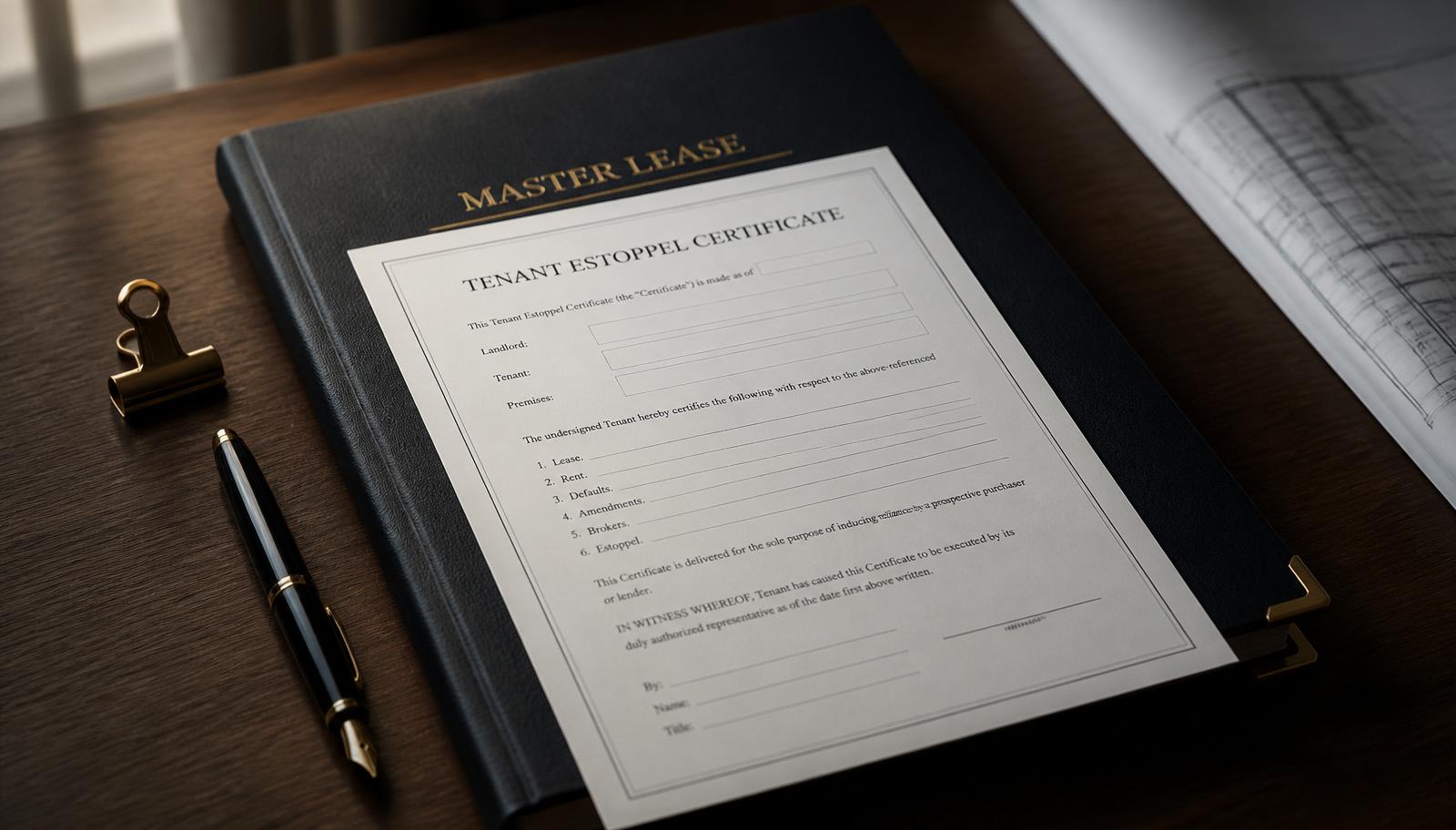
A tenant estoppel certificate, often called an estoppel, is a written statement signed by a tenant that confirms specified facts about the lease as of a particular date. It commonly addresses rent, deposits, lease dates, renewal rights, defaults, amendments, concessions, and outstanding landlord obligations.
Buyers and lenders use estoppels to compare the tenant's statements with the leases, rent roll, and seller's representations. For an owner preparing to sell or refinance, organizing the estoppel process early can reduce surprises and help keep due diligence on schedule.
This article provides general information, not legal advice. Estoppel language, deadlines, remedies, and legal effect depend on the lease, governing law, transaction documents, and specific facts. Owners, buyers, lenders, and tenants should consult qualified commercial real estate counsel.
What Is a Tenant Estoppel Certificate?
A tenant estoppel certificate is a signed statement in which a tenant confirms defined facts about its lease and occupancy. The exact form varies by transaction and asset type, but the purpose is consistent: to give the buyer or lender a current, tenant-confirmed view of the lease relationship.
The estoppel does not replace the lease. It supplements due diligence by identifying whether the tenant's understanding matches the documents and financial records provided by the landlord.
Because the statement may have legal consequences, the requesting party should use a form that aligns with the lease and transaction documents, and each party should have counsel review material issues.
What a Tenant Estoppel Certificate Usually Confirms
A commercial tenant estoppel commonly asks the tenant to verify several categories of information.
Rent, Additional Charges, and Security Deposits
The form may confirm current base rent, common-area maintenance charges, triple-net reimbursements, percentage rent if applicable, prepaid rent, and the amount and form of the security deposit.
These figures are compared with the rent roll, lease, amendments, and landlord accounting records. Differences should be resolved before closing rather than left for the new owner to discover afterward.
Lease Dates and Tenant Rights
The certificate typically identifies the lease commencement date, expiration date, and any remaining options to renew, expand, terminate, purchase, or take additional space. It may also confirm rights of first offer or refusal, exclusivity provisions, and other tenant rights that could affect value or future leasing.
Amendments, Concessions, and Side Agreements
Buyers and lenders want to know whether the written lease is the complete agreement. The estoppel may ask the tenant to identify amendments, free-rent periods, tenant-improvement allowances, uncredited payments, or side agreements that are not reflected in the original lease.
Defaults and Outstanding Obligations
The tenant may be asked to state whether the landlord or tenant is in default and whether the tenant has any existing claims, defenses, offsets, or unresolved repair requests. Any response should be reviewed carefully because it may affect closing conditions, pricing, escrow, or post-closing obligations.

Why Buyers and Lenders Request Estoppels
Commercial property value often depends on lease income. A buyer needs reasonable confidence that the income, lease term, tenant rights, and deposit balances presented during underwriting are accurate.
For example, suppose the seller's records show monthly rent of $5,000 and a $10,000 security deposit. If the tenant reports a different rent amount, an additional concession, or a larger deposit, the discrepancy may change cash flow, closing adjustments, or the buyer's willingness to proceed.
A signed estoppel can help establish the tenant's stated position as of the date of the certificate. Its precise legal effect varies, so parties should avoid treating it as absolute protection. The key benefit is that it brings potential disagreements into the open before the transaction closes.
The purchase and sale agreement often defines the seller's estoppel obligations. It may specify the required form, delivery deadline, acceptable exceptions, percentage of occupied space that must be covered, and whether named major tenants must provide certificates. These requirements should be reviewed alongside the commercial real estate purchase and sale agreement and the earlier commercial real estate letter of intent.
Common Estoppel Problems During a Property Sale
Estoppel collection can create delay when it begins too late or when the lease files are incomplete.
The Tenant Does Not Respond
Tenants may view the request as an administrative burden, route it through corporate legal departments, or simply fail to prioritize it. Owners should review each lease for its notice method, response period, required form, and available remedies before sending requests.
Some leases contain response deadlines or provisions addressing a tenant's failure to respond. The wording and enforceability of those provisions vary. Do not assume that an owner can sign for a tenant or treat silence as approval without advice from qualified counsel.
The Tenant Identifies a Dispute
A tenant may report an unresolved repair, disputed operating-expense reconciliation, incorrect deposit, promised improvement, rent credit, or other disagreement. The issue may be valid, mistaken, or based on an undocumented conversation.
The owner should investigate the discrepancy promptly and coordinate with counsel, the buyer, and the tenant. Trying to pressure the tenant into changing an accurate response can create greater risk.
The Estoppel Conflicts with the Lease or Rent Roll
Differences may result from missing amendments, accounting errors, unrecorded concessions, or a tenant misunderstanding. The transaction team should create a discrepancy log that identifies the issue, supporting documents, responsible party, and resolution status.
Major Tenants Require Extended Review
National or regional tenants may route estoppels through internal legal, lease-administration, or compliance teams. Their turnaround time can be longer than the general tenant population. Start with major tenants early and follow the notice process required by the lease.
Commercial property owners can also consult BOMA International resources for broader building-management and lease-administration practices, while relying on qualified legal counsel for the specific estoppel language and transaction.
How Owners Can Prepare Before Requesting Estoppels
Preparation should begin before the buyer's formal request arrives.
First, audit the lease file for every occupied space. Confirm that the file contains the original lease, amendments, assignments, guaranties, renewal notices, expansion agreements, commencement-date letters, and any material correspondence.
Next, reconcile the lease files against the rent roll and accounting system. Check base rent, escalations, additional rent, deposits, credits, arrears, options, and expiration dates.
Then review the estoppel clause in each lease. Record the required form, notice address, delivery method, response deadline, permitted recipients, and any lease-specific limitations.
Finally, create a tracking system for the transaction. At minimum, track:
- Tenant name and suite
- Lease and amendment status
- Estoppel form sent
- Date and method of delivery
- Contractual response deadline
- Tenant contact and corporate reviewer
- Date returned
- Exceptions or discrepancies
- Resolution owner
- Buyer or lender approval status
Organized files and a clear tracker reduce last-minute confusion and make it easier to identify which certificates remain outstanding.
Estoppels in a Direct Off-Market Sale
A direct off-market sale does not eliminate the need to verify leases. Estoppels may remain an important part of the buyer's due diligence, particularly for multi-tenant retail, office, industrial, and net-lease properties.
The potential advantage is a more focused transaction with fewer parties and, when the buyer uses its own capital, less dependence on a conventional mortgage lender's separate approval process. Every sale still remains subject to the negotiated purchase agreement, due diligence, title review, tenant documentation, and final approval.
Owners should compare the complete transaction, not only the headline price. Timing, confidentiality, buyer capability, required estoppel thresholds, existing brokerage obligations, legal costs, and the risk of a late price adjustment can all affect the outcome.
For more context on private transaction structures, review Price Capital Group's guide to selling commercial property off market.
Evaluate Your Commercial Property Position
If you are preparing to sell a leased commercial asset, review the rent roll, lease files, deposits, tenant correspondence, outstanding landlord work, and estoppel clauses before starting the transaction.
Use Price Capital Group's cap rate calculator to test how verified net operating income may affect estimated value. If you would like a confidential property review, submit your property to Price Capital Group.
Submitting a property does not guarantee an offer, approval, or closing. Every transaction is subject to underwriting, due diligence, title review, documentation, and final approval.
Submit a PropertyRelated Reading
This article is provided for general informational purposes only and does not constitute legal, tax, investment, appraisal, or brokerage advice. Commercial leases, estoppel certificates, and transaction documents should be reviewed by qualified counsel familiar with the property and applicable law.