
Commercial Real Estate
The Definitive Guide to Cap Rates in Commercial Real Estate
Learn how commercial real estate cap rates measure yield, risk, financing pressure, and property value, and why advertised pro-forma returns require careful underwriting.
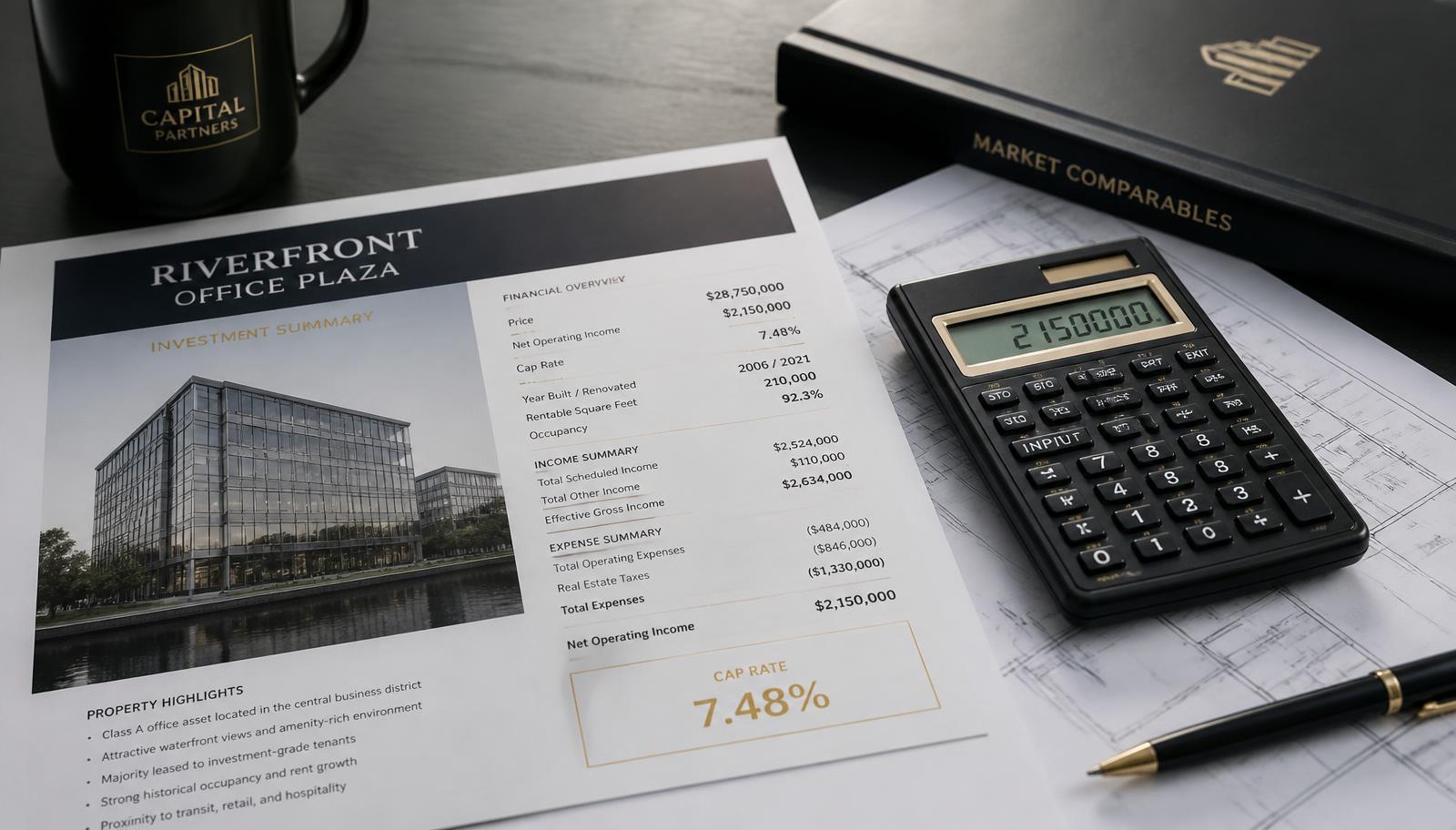
In the commercial real estate industry, one metric dominates almost every conversation, listing brochure, and underwriting model: the Capitalization Rate, universally known as the cap rate. Whether you are acquiring a multi-tenant industrial warehouse, underwriting a Triple Net (NNN) retail pad, or liquidating a legacy multifamily portfolio, the cap rate is the universal language of commercial property valuation. However, while the math behind a cap rate is simple, relying on it blindly without understanding the operational and market mechanics beneath it is one of the fastest ways to lose capital.
As we consistently emphasize across our deal breakdowns, a property's advertised cap rate is merely a starting point. Here is the complete breakdown of how cap rates actually work, how they measure risk, and how institutional investors manipulate them to force appreciation.
The Cap Rate Formula and Core Mechanics
At its most basic level, a cap rate represents the unleveraged annual rate of return an investor would receive if they purchased a commercial property entirely in cash. It is a snapshot of the property's yield over a single twelve-month period.
The mathematical formula is absolute:
For example, if you purchase a self-storage facility for $5,000,000 and it generates $350,000 in NOI after all operating expenses (but before debt service), the asset is operating at a 7% cap rate.
The Inverse Relationship: Value vs. Yield
The most critical concept for property owners to master is the inverse mathematical relationship between the cap rate and the property's value.
- As cap rates compress (go down), property values go up.
- As cap rates expand (go up), property values go down.
If that same $350,000 NOI is suddenly valued by the market at a 5% cap rate (perhaps due to falling interest rates or a surge in local demand), the property's value immediately leaps to $7,000,000.
$350,000 ÷ 0.05 = $7,000,000
What a Cap Rate Actually Tells You: The Risk Premium
A cap rate is not simply a measure of return; it is fundamentally a measure of risk. Investors demand a higher rate of return (a higher cap rate) when they take on more operational or market risk. Conversely, they are willing to accept a lower yield (a lower cap rate) in exchange for absolute stability. Professional valuation organizations such as the CCIM Institute publish extensive coursework on how disciplined underwriters translate risk into required yield.
The Low Cap Rate (Safe & Stabilized)
In our underwriting breakdown on Commercial Real Estate Lending: The Burger King Deal, we analyzed a freestanding retail property generating $147,000 a year backed by a 20-year corporate lease. Because the income stream is guaranteed by a multi-billion dollar corporation and requires zero landlord maintenance, the risk is incredibly low. Consequently, properties like this trade at aggressive, low cap rates (roughly 5% to 6%). You pay a premium for safety.
The High Cap Rate (Value-Add & Operational Risk)
If a broker brings you an aging, Class C multifamily building with deferred maintenance and high tenant turnover advertised at a 9% cap rate, that higher yield is compensating you for the immense operational friction you are about to inherit. The risk of eviction, roof leaks, and vacancy requires a higher return to justify the capital deployment.
The Danger of the "Pro-Forma" Cap Rate
One of the most dangerous traps in commercial real estate is the broker's "pro-forma" cap rate. Listing agents frequently market properties based on projected future income rather than the actual, trailing-twelve-month (TTM) financial reality.
As Jason highlighted on The Route EP 1: Commercial Property Inspection Gone Wrong, the numbers on a listing flyer rarely survive contact with the physical real estate. In that episode, our team drove out to inspect a 34,000-square-foot multi-tenant building listed at $8.9 million, boasting $367,000 in NOI.
On paper, the broker was pushing a valuation near a 4% cap rate. However, when we put boots on the ground and talked to the maintenance staff, we uncovered failing parking lots, severe drainage problems, and a tenant base paying well below market rent.
At a more realistic 6% cap rate adjusted for those risks, that same $367,000 in income only supported a valuation of about $6 million. That is a $3 million gap between the asking price and the reality of the math. This is why due diligence must verify every line item of the NOI. If the NOI is inflated, the cap rate is a fiction, and the asset is vastly overpriced.
Cap Rate Spread and Interest Rates
Cap rates do not exist in a vacuum; they are heavily influenced by the macroeconomic environment, specifically U.S. Treasury yields and commercial mortgage rates. Investors measure the viability of a deal by looking at the spread, the difference between the property's cap rate and the cost of borrowing capital.
- If commercial mortgage rates are at 4%, borrowing money to buy a 6% cap rate property creates positive leverage.
- If interest rates jump to 7%, buying that same 6% cap rate property results in negative leverage. The property does not generate enough yield to cover the cost of the debt used to acquire it.
When debt becomes expensive, buyers demand higher cap rates to maintain their spreads, driving overall property values down.
Bypassing Market Fluctuations with a Direct Cash Exit
Navigating cap rate compression, changing interest rates, and broker pro-formas introduces severe transaction risk for property owners looking to liquidate. If you list your property on the public market and interest rates rise during your buyer's 90-day due diligence window, their debt costs will spike. This frequently leads to the buyer demanding a massive price reduction at the last minute because their required cap rate has shifted.
Executing a direct off-market sale to an established corporate cash buyer eliminates this risk entirely. Private acquisition groups utilize dedicated equity pools, removing conventional bank financing and appraisal contingencies from the equation. This ensures that the valuation you agree upon is the exact amount funded at closing, completely independent of commercial mortgage market volatility.
To evaluate how your property's NOI aligns with current institutional underwriting, stress-test your exact numbers using our interactive cap rate calculator. If you are preparing to sell an asset and want a guaranteed corporate cash evaluation, Submit a Property to our direct acquisition team for a confidential review today. For an in-depth breakdown of private transactions, explore our master guide on selling commercial property off market.
Submit a PropertyRelated Reading
This article is provided for general informational purposes only and does not constitute legal, tax, investment, appraisal, or brokerage advice. Every transaction is subject to underwriting, due diligence, title, documentation, and final approval on the specific property.