
Asset Liquidation & Dispositions
Liquidation and Redevelopment Strategies for Distressed South Florida Golf Courses
How environmental diligence, covered-land underwriting, entitlements, and disposition strategy shape a distressed golf-course sale.
For decades, master-planned golf communities anchored the real estate landscape of Palm Beach and Broward counties. Legacy syndicators and independent operators generated revenue from club memberships, daily greens fees, and catering events on large, centrally located parcels.
Some older South Florida golf courses face operating pressure from maintenance costs, irrigation, insurance, capital needs, membership trends, and changing land values. When those pressures combine, a long-held recreational property can move toward distress.
For an owner weighing a sale, understanding how redevelopment-oriented buyers value the land can help an owner evaluate disposition alternatives. That analysis differs from underwriting an operating golf business, and it does not guarantee a particular price, timeline, or closing.
1. Environmental Diligence and Potential Arsenic Contamination
Older golf courses may warrant targeted environmental diligence because historic turf-management practices can be associated with arsenic, pesticides, or other contaminants. Decades of pesticide, herbicide, and fertilizer application mean that historic pesticide and herbicide use can create soil or groundwater concerns at some golf-course properties, including arsenic impacts.
This is a documented concern, not a universal condition. A Florida Department of Environmental Protection Contaminated Soil Forum study, Assessment of Arsenic Mobility in the Soils of Some Golf Courses in South Florida, detected high arsenic concentrations in soils and underlying groundwater at some South Florida golf courses, indicating possible impact from arsenic-containing herbicides. Florida precedent also exists at the property level: the former Westview golf course in Miami-Dade had arsenic, dieldrin, and toxaphene impacts and was redeveloped for commercial and industrial use using remediation and engineering controls, and a Broward former golf-course brownfield documented arsenic impacts associated with historic herbicide use. These are examples, not evidence that every golf course carries the same contamination.
A Phase I Environmental Site Assessment is often the starting point for environmental due diligence. A Phase II investigation may follow where recognized environmental conditions or suspected contamination justify sampling. A Phase II is not automatically required for every property.
Confirmed or suspected contamination can increase diligence, affect valuation, reduce lender appetite, require remediation planning, or change the financing structure. Lenders and buyers assess the identified environmental conditions, available reports, regulatory status, cleanup obligations, and risk-allocation structure. Environmental uncertainty can make conventional financing more difficult, especially where cleanup scope or liability is unresolved.
Cleanup is site-specific. The DEP's waste cleanup program distinguishes among site assessment, risk assessment, source removal, remedial action, natural attenuation, monitoring, and conditional closure strategies. Environmental management may involve excavation, soil management, engineering controls, monitoring, risk-based closure, or other remedies approved for the specific site. The DEP's former-golf-course examples include both soil removal and engineering controls, so not every property requires removal of all affected soil.
2. Institutional Underwriting: The Covered Land Play
A redevelopment-oriented buyer may value the existing golf operations, improvements, and land separately and may place greater weight on the underlying redevelopment potential where the existing operation is underperforming. A covered-land strategy evaluates an operating or improved property partly for its underlying land and future redevelopment potential.
Factors may include acreage, assemblage, frontage, access, utilities, drainage, environmental condition, comprehensive-plan designation, zoning, density, neighboring uses, infrastructure, market demand, and entitlement risk. Large contiguous sites can be difficult to assemble in built-out South Florida submarkets, which can make golf-course acreage strategically interesting to certain developers.
Two potential highest-and-best-use scenarios illustrate the analysis:
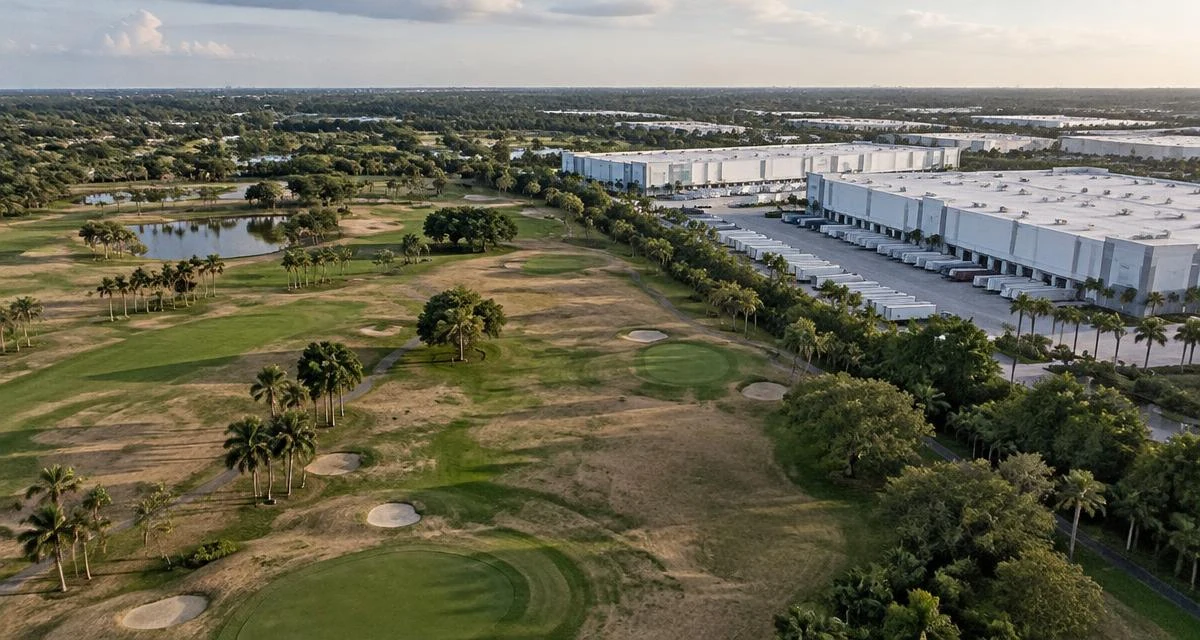
- Industrial redevelopment. Golf-course acreage near transportation infrastructure may be evaluated for industrial redevelopment where comprehensive-plan designation, zoning, access, utilities, environmental conditions, and municipal approvals support the use. Proximity to I-95 or the Florida Turnpike alone is not sufficient.
- Residential redevelopment. A golf-course site may also be evaluated for single-family, multifamily, mixed-use, or other residential development where density, land-use, infrastructure, environmental, school-capacity, traffic, and entitlement requirements support the plan.
A simplified residual-value framework can be expressed as:
Residual Land Value = Future Redevelopment Value − (Remediation + Entitlement Risk + Holding Costs)
This is a conceptual starting point, not an appraisal formula or a guaranteed purchase price. The entitlement-risk term represents an estimated monetary allowance or discount, not a probability subtracted from dollars. Redevelopment may also require reconfiguration of ponds, stormwater systems, drainage, or other site infrastructure, subject to environmental and water-management approvals. A complete model also considers demolition, carrying costs, financing, contingency, timing, transaction costs, and the buyer's required return.
3. Navigating the Entitlement Timeline and Capital Structure
Redeveloping a golf course requires the owner or buyer to seek the required land-use and zoning approvals. Major land-use and zoning changes can require a lengthy entitlement process. Timing varies by municipality, project scope, environmental issues, traffic analysis, public hearings, community opposition, and required agency approvals. A two-to-three-year horizon is sometimes used as an illustrative planning scenario, not a universal estimate.
Redevelopment of a golf course adjacent to residential neighborhoods can attract substantial community scrutiny, particularly where residents purchased homes expecting long-term open-space or golf-course views. The process is a land-use, zoning, public-hearing, technical-review, and community-engagement process, and outcomes are not assured.
Unentitled land, unresolved contamination, negative carrying costs, or speculative redevelopment plans can make conventional bank financing more difficult or require greater equity. Developers may use sponsor equity, joint-venture equity, preferred equity, land financing, private bridge debt, seller financing, or other capital structures depending on the acquisition and entitlement plan. Private lenders may consider current land value, acquisition basis, entitlement status, environmental risk, leverage, sponsor liquidity, carry costs, and the proposed exit in addition to potential future value. Financing may include approved acquisition, carrying, remediation, entitlement, or redevelopment costs where supported by underwriting and loan documents, but no financing structure guarantees full funding of cleanup or approvals.
4. Evaluating a Direct Sale of a Distressed Golf Course
Owners may evaluate both brokered marketing and direct-sale alternatives depending on timing, confidentiality, property complexity, and desired buyer universe. Financed buyers may require environmental, entitlement, title, land-use, valuation, and lender diligence that can increase execution time. Brokerage fees are negotiated and vary by transaction.
A direct sale to a redevelopment-oriented buyer can be an alternative disposition strategy. A redevelopment buyer may be more willing to evaluate known environmental complexity if the expected remediation cost, liability allocation, land value, and redevelopment economics support the transaction. Some redevelopment buyers may accept substantial physical or environmental complexity subject to diligence and negotiated purchase terms.
Environmental liability allocation depends on applicable law, ownership history, regulatory status, contractual indemnities, cleanup obligations, and transaction structure. A seller is not automatically released from liability, and no buyer should be described as indifferent to environmental risk. A direct transaction can provide a more controlled marketing process and may reduce some financing dependencies, but timing and confidentiality depend on diligence and negotiated terms.
Following the process discipline discussed in The Discipline Loop: Why Your Process Beats Your Goals, owners can compare net proceeds, timing, certainty, and remaining obligations across potential transactions while pursuing required municipal and agency approvals.
To evaluate the current income-producing golf operation, you can start with our cap rate calculator, recognizing that a capitalization-rate calculation based on current NOI does not by itself value a covered-land redevelopment opportunity. Redevelopment analysis also depends on land value, entitlement probability, remediation, infrastructure, holding costs, density or floor-area ratio, exit value, and development costs. For a broader view of private transactions, explore our guide to selling commercial property off market.
If you are evaluating the sale or redevelopment of a South Florida golf-course property, Submit a Property for a confidential review.
Related Reading
This article is general educational information, not legal, environmental, zoning, lending, or investment advice. Environmental conditions, remediation obligations, entitlement outcomes, valuation, and transaction results depend on the property, agreements, agency requirements, and applicable law. Consult qualified counsel, engineers, environmental professionals, and advisers before acting.