
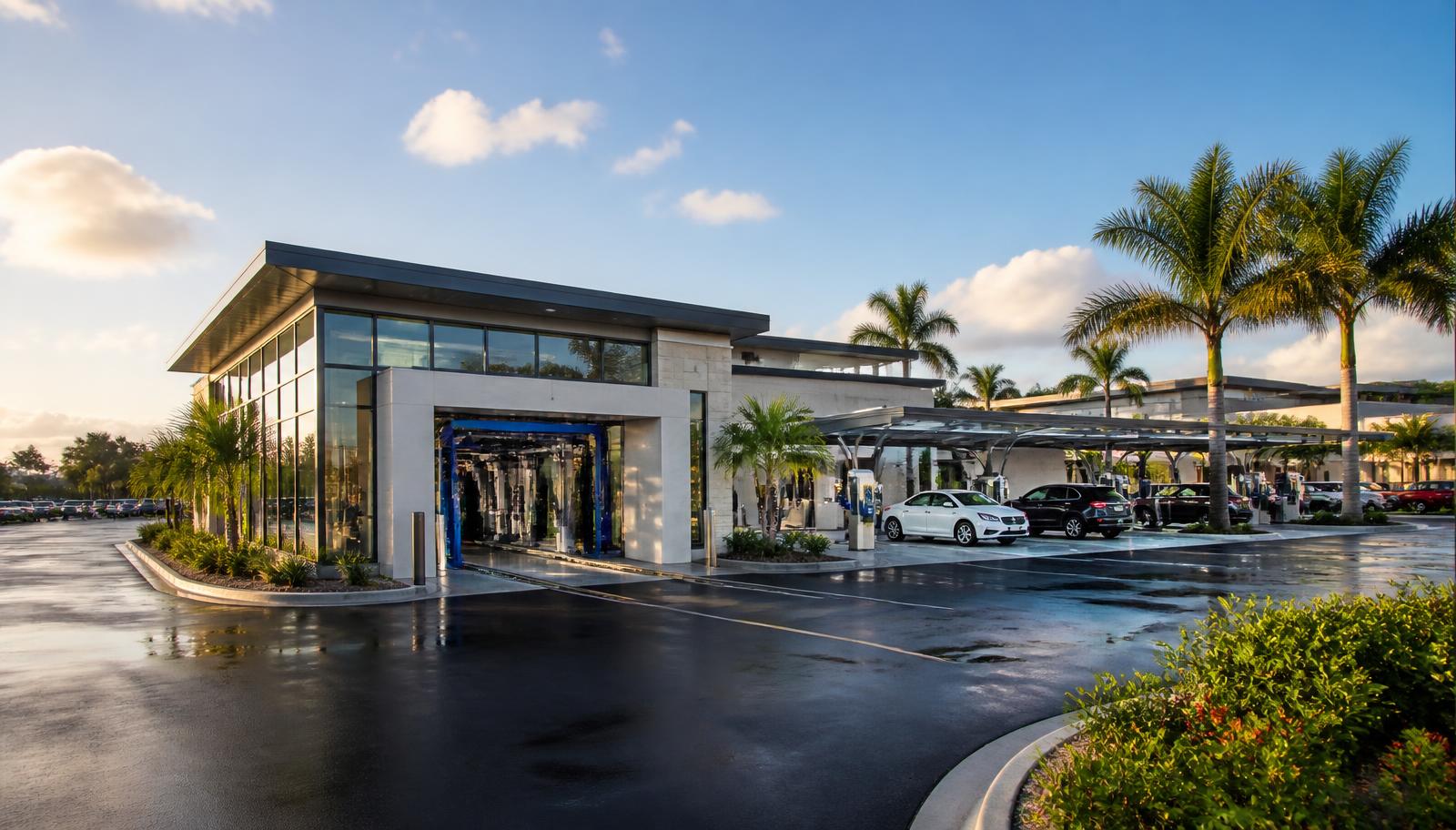
Commercial Property Sales
Liquidation Strategies for South Florida Express Car Washes and Automotive Service Facilities
How corporate cash buyers underwrite EBITDA multiples, cap rates, and environmental risk when acquiring South Florida car washes and automotive service facilities.
South Florida is the ultimate vehicular market. With millions of daily commuters spanning Miami-Dade, Broward, and Palm Beach counties, demand for automotive service centers, collision repair shops, and express exterior car washes is unrelenting. For decades, owning an independent automotive service facility or a neighborhood car wash on a high traffic corner has been a lucrative, high yield asset for independent operators.
Operating a specialized automotive or car wash facility in South Florida today, however, requires navigating significant localized headwinds. The industry is undergoing rapid institutional consolidation. Private equity backed express wash chains are expanding aggressively, while environmental agencies and local municipalities apply increasing scrutiny to independent operators. When a private owner reaches a point of management fatigue, whether facing a major equipment overhaul, exhaustion from environmental compliance, or a desire to monetize the underlying real estate equity, understanding how corporate acquisition groups underwrite automotive and car wash facilities is essential to securing a fast, premium off market cash exit.
The Localized Headwinds Squeezing Florida Automotive Operators
While daily vehicle counts across South Florida continue to rise, the baseline carrying costs and capital expenditure requirements needed to keep an older car wash or automotive center operational are steadily eroding Net Operating Income (NOI).
1. Severe Water Reclamation and Environmental Mandates
Automotive centers and car washes face increasing environmental scrutiny. Some municipalities across South Florida enforce water shortage restrictions and require water reclamation systems depending on local rules and permitting history. For independent operators, retrofitting an older tunnel to comply with modern water recycling requirements or installing new oil grit separators in a service bay can require large, unbudgeted capital expenditures.
2. Zoning Moratoriums and Traffic Stacking Scrutiny
Because of the recent expansion of express car washes, several Florida municipalities have imposed zoning moratoriums to limit over saturation and traffic congestion. Where new supply is restricted, existing grandfathered locations may become more valuable, though municipal scrutiny generally increases at the same time. If an older facility has short driveways that cause cars to stack into the public roadway, code enforcement can penalize the operation.
3. The Private Equity Arms Race and Equipment CapEx
The car wash industry is no longer a mom and pop real estate play. It is a scalable, subscription based operating business, a shift documented across the sector by the International Carwash Association. Independent operators now compete directly against well capitalized private equity backed platforms with monthly membership apps and modern conveyor tunnels. To stay competitive, an independent owner often has to fund hundreds of thousands of dollars in tunnel equipment upgrades, a capital drain that prompts many to seek a clean exit.
How Institutional Capital Underwrites Car Washes and Auto Facilities
When private equity firms, automotive consolidators, and direct corporate cash buyers evaluate a South Florida express car wash or automotive service center, they use a specific underwriting model. They separate the operating business from the physical dirt.
1. EBITDA Multiples vs Real Estate Cap Rates
Corporate buyers do not value a car wash solely on the physical real estate. They underwrite the Trailing Twelve Month (TTM) EBITDA of the active business. Institutional buyers typically apply a multiple to the operating business and a separate capitalization rate to the physical real estate. As covered in What Is a Cap Rate? Running the Numbers on Three Fort Myers Warehouses, the underlying real estate valuation has to align with mathematical reality. Our guide to cap rates and commercial real estate valuation walks through the same math in detail.
2. The Sale Leaseback Arbitrage
Corporate buyers frequently execute a sale leaseback strategy on automotive facilities. If a private equity group acquires a collision center, it will underwrite the physical dirt based on projected rental income. Net lease investors currently price prime South Florida car wash real estate aggressively, and cap rates vary by location, tenant credit, lease structure, and market conditions.
3. Physical Feasibility and Environmental Realities
As shown in This Property Looked Like a Deal Until We Got There, rigorous physical due diligence and underwriting is mandatory. Corporate buyers inspect underground storage tanks, hydraulic lifts, and chemical runoff drainage closely. If the facility needs environmental remediation, buyers will quantify those costs and typically account for them in pricing. Adhering to a disciplined process, as outlined in The Discipline Loop: Why Your Process Beats Your Goals, keeps buyers from overpaying for environmentally compromised dirt.
Bypassing Escrow Delays with a Direct Cash Sale
When an independent owner decides to liquidate an automotive facility or car wash, the transaction vehicle dictates the speed and confidentiality of the deal.
Listing a specialized automotive property through a traditional commercial brokerage introduces friction. Public marketing signals to employees and monthly subscription members that the business is changing hands, which often causes operational disruption and staff turnover. Traditional buyers relying on conventional commercial bank loans also face lengthy underwriting timelines that can run ninety days or more.
Many lenders apply additional environmental scrutiny to automotive uses. A Phase One Environmental Site Assessment on an auto shop may recommend further investigation, including a Phase Two soil and groundwater test. If historical oil or chemical contamination is discovered, financing may be reduced, delayed, or declined outright.
Executing a direct off market sale to an established corporate cash buyer can reduce these financing related execution risks. Private acquisition groups use dedicated, discretionary cash pools, allowing them to purchase car washes and automotive facilities as is, absorbing deferred equipment maintenance, environmental indemnifications, and employee transition friction. This model can avoid conventional bank financing contingencies, may avoid negotiated brokerage commissions, and can support a faster, more confidential closing that protects ongoing operations. For a full breakdown of the process, see our guide to selling commercial property off market.
As Jason highlights in Why Most Businesses Fail Before They Even Start, a lack of rigid operational systems kills growth. Relying on a fragile bank loan to exit a complex automotive asset is a flawed process. Direct corporate cash evaluation removes much of that uncertainty.
Plan a Clean Exit from Your Car Wash or Auto Facility
To test how corporate buyers measure your property's yield under current market parameters, run your figures through our interactive cap rate calculator. If you are ready to move without public marketing exposure, Submit a Property for a confidential review by our direct acquisition team.
Submit a PropertyRelated Reading
This article is provided for general informational purposes only and does not constitute legal, tax, environmental, accounting, investment, appraisal, or brokerage advice. Environmental compliance and zoning obligations vary by site, county, and use history. Every transaction is subject to underwriting, due diligence, title, documentation, and final approval on the specific property.