
Commercial Property Sales
Liquidation Strategies for South Florida Single Tenant Net Lease and QSR Retail Pads
How institutional capital underwrites corporate credit, rent to sales coverage, drive thru entitlements, and dark box risk on freestanding retail pads across South Florida.
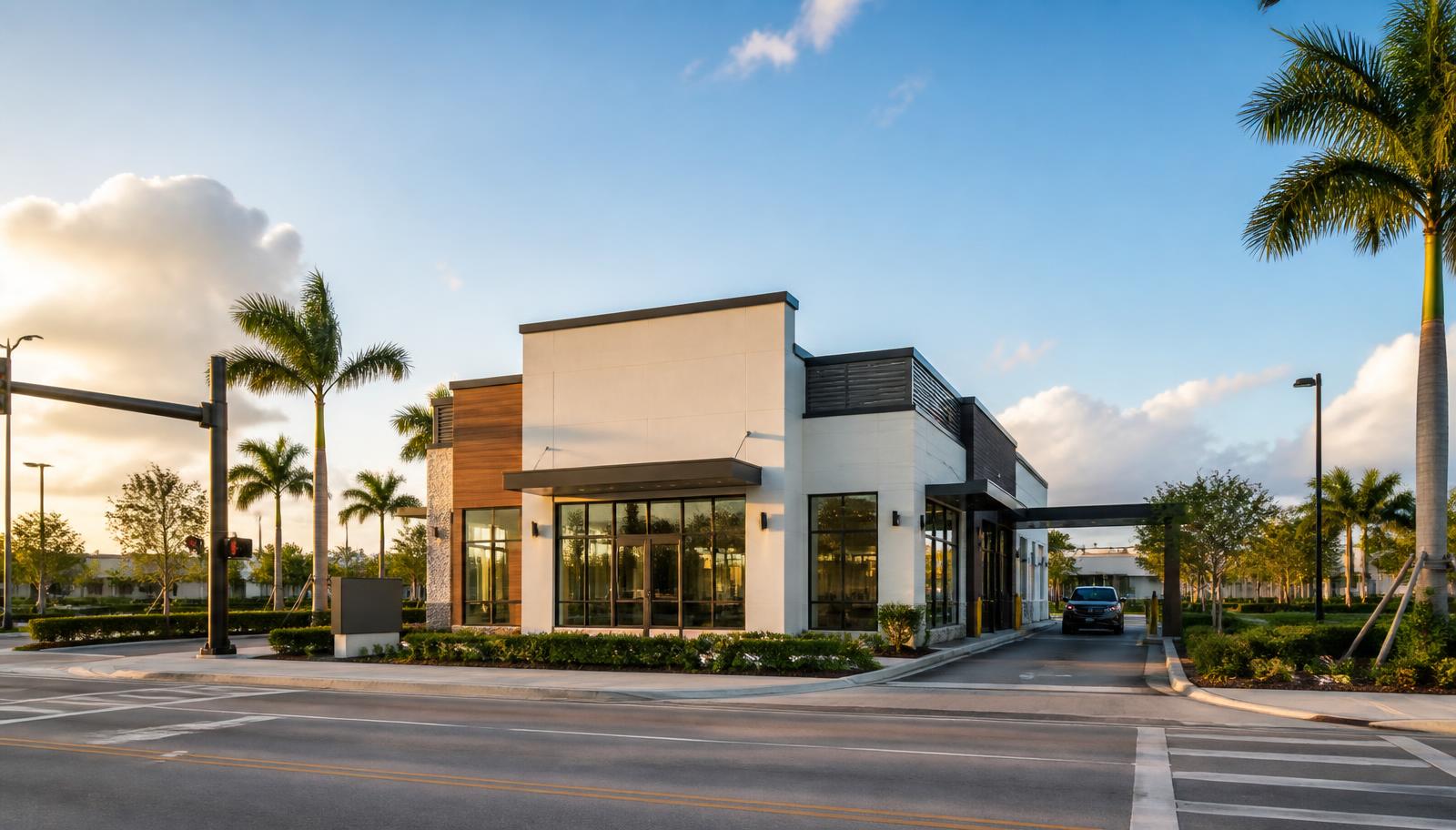
Driven by tourism, population growth, and heavy commuter traffic, the commercial corridors spanning Miami-Dade, Broward, and Palm Beach counties remain prime territory for single tenant net lease and quick service restaurant (QSR) properties. For decades, owning a fast food pad, a corporate pharmacy, or a freestanding bank branch in South Florida has been treated as a passive wealth vehicle. These properties offer predictable cash flow, limited landlord maintenance, and high visibility real estate.
The operational reality of holding a single tenant asset shifts as the primary lease term nears expiration. Legacy owners are navigating franchise consolidation, aggressive corporate lease renegotiations, and shifting consumer retail habits. When an owner decides to exit, whether to avoid a vacant dark box, execute a 1031 exchange, or liquidate a family trust, understanding how institutional capital underwrites freestanding retail pads is central to securing a fast off market cash exit.
The Localized Headwinds Squeezing Florida Single Tenant Owners
While an absolute triple net structure shields the landlord from daily maintenance, holding a single tenant property in South Florida carries concentrated binary risk. The asset depends entirely on the survival and cooperation of one business.
1. The Looming Dark Box and Lease Expiration Risk
The value of a single tenant net lease asset is tied to the remaining term on the lease. A freestanding retail pad with fifteen years remaining on a corporate guarantee can command a pricing premium, depending on lease term, tenant credit, location, and buyer requirements. Once that same lease drops below five years, value becomes far more volatile. If the corporate tenant relocates to a newer build to suit location down the street, the landlord is left with a specialized, vacant concrete box. Retrofitting a former fast food restaurant or bank branch for a new tenant requires significant capital.
2. Franchisee Credit Risk vs Corporate Guarantees
South Florida is heavily saturated with QSR franchise operators. Friction arises when a landlord realizes the lease is not guaranteed by the national corporate parent, but by a local franchisee entity operating only three or four units. If that operator mismanages cash flow, the landlord faces immediate default risk. As Jason outlines in Why Most Businesses Fail Before They Even Start, a lack of rigid financial systems is what breaks small business operators. When a franchisee fails, the landlord absorbs the loss of income. Retail industry bodies such as ICSC track how franchise structures and store level performance shape retail tenant renewal behavior.
3. Drive Thru Zoning and Traffic Engineering Scrutiny
Municipalities across South Florida are restricting new drive thru permits to limit congestion on primary arteries such as US 1 and Federal Highway. That scarcity makes existing drive thru properties more valuable, but it also means that if a property loses grandfathered zoning status during a prolonged vacancy, a drive thru may never be permitted on that dirt again, permanently impairing asset value.
How Institutional Capital Underwrites South Florida STNL Properties
When private equity firms, net lease REITs, and direct corporate cash buyers evaluate a South Florida single tenant net lease property, they underwrite tenant credit, unit level profitability, and the dark value of the real estate itself.
1. Auditing the Lease Guarantee and Rent to Sales Ratio
Corporate buyers look past the rent amount to the financial health of the business paying it. Institutional buyers ask for unit level store sales reporting so they can calculate the rent to sales ratio. If a QSR location generates two million dollars in annual sales and pays one hundred thousand dollars in rent, the ratio is a healthy five percent. If the ratio climbs above ten percent, buyers treat the location as a higher risk for future closure and discount the purchase price accordingly.
2. The Dark Value of the Dirt
Conservative capital allocators stress test the worst case. If the tenant vacates tomorrow, what is the raw dirt worth? In our breakdown of Would You Lend 800K on This Burger King Deal, the safety of the transaction rested on the underlying real estate value. The property generated $147,000 in net operating income (NOI), but the real cushion was that the signalized hard corner dirt was worth well over the loan amount. Institutional buyers underwrite that replacement cost to set their pricing floor.
3. Stress Testing the Yield
As highlighted in What Is a Cap Rate? Running the Numbers on Three Fort Myers Warehouses, asking prices have to align with mathematical reality. For a single tenant net lease property, valuation is a direct capitalization of current NOI, adjusted for the credit of the tenant and the remaining lease term.
Underwriting single tenant assets takes discipline. Following the principles in The Discipline Loop: Why Your Process Beats Your Goals, corporate buyers will pass on a property when the franchisee credit profile does not meet their risk parameters, regardless of how attractive the real estate looks.
Bypassing Escrow Friction with a Direct Cash Sale
When an independent owner decides to liquidate a single tenant net lease property, the transaction vehicle dictates the speed and net proceeds of the deal.
Listing a retail pad through a traditional commercial brokerage introduces execution risk. Public marketing alerts your tenant that the property is in transition, which can complicate upcoming lease renewal negotiations. Traditional buyers relying on conventional bank financing also face slow underwriting. If a bank underwriter sees a dip in the franchisee's trailing twelve month revenue, or the remaining lease term is shorter than the requested amortization schedule, the lender may deny or reduce the financing.
Executing a direct off market sale to an established corporate cash buyer can reduce these vulnerabilities. Private acquisition groups use discretionary cash pools, allowing them to purchase freestanding retail pads as is while assuming lease renewal risk and tenant transition friction. This model bypasses conventional bank financing contingencies, may avoid negotiated brokerage commissions, and can support a faster, confidential closing.
Evaluate Your South Florida Retail Pad
To evaluate how corporate buying groups analyze your retail pad yield under current South Florida market parameters, test your figures in our interactive cap rate calculator. If you are tired of managing lease extension negotiations and want a direct corporate cash evaluation, Submit a Property to our acquisition team for a confidential review. For an in depth breakdown of private transactions, explore our master guide on selling commercial property off market.
Submit a PropertyRelated Reading
This article is provided for general informational purposes only and does not constitute legal, tax, investment, appraisal, or brokerage advice. Lease terms, guarantees, zoning, and entitlement requirements are property and jurisdiction specific. Every transaction is subject to underwriting, due diligence, title, documentation, and final approval on the specific property.